
Why Your Manifestation Practice Isn’t Working (And the 3 Things That Actually Do)
Reading Time: 8 minutes
You have done the vision boards. You have written the affirmations. You have visualised the life you want every morning for months — maybe years. And yet, standing where you are right now, the gap between where you started and where you wanted to be feels just as wide as it ever did.
You are not broken. You are not doing it wrong. You are probably just doing an incomplete version of it.
Manifestation has been sold to us as a feeling practice. Think the right thoughts, feel the right feelings, attract the right outcomes. And while there is truth in that framework, it is missing two-thirds of what actually makes it work.
What Manifestation Actually Is (And What It Is Not)
Let us start with an honest definition, because a lot of confusion begins here.
Manifestation is not magic. It is not the universe rewarding positive thinkers with good parking spots and surprise cheques. It is not thinking your way to outcomes while waiting passively for the world to rearrange itself around your desires.
What manifestation actually is — at its most useful — is the deliberate alignment of your thoughts, your beliefs, and your actions toward a specific outcome. It is a framework for intentional living. It is the practice of getting clear enough about what you want, honest enough about what you believe is possible, and disciplined enough to move toward it consistently.
When all three of those things are in alignment, things begin to shift. Not because the universe has noticed your vibration — but because you have become someone who is genuinely oriented toward what you want, and you are taking the steps to get there.
The problem is that most people stop at the first pillar.
The Three Pillars That Make Manifestation Work
Pillar One: Vision and Clarity
You cannot move toward something you cannot clearly see. This sounds obvious until you actually sit down and try to describe, in specific detail, what you want your life to look like.
Most people, when pressed, discover that their vision is surprisingly vague. “I want to be successful.” “I want to feel happy.” “I want more.” These are not visions. They are feelings without form. And your brain — which is extraordinary at solving specific problems — cannot solve for a destination it cannot locate.
Vision work means getting precise. Not just what you want, but where you are, who you are with, how your body feels, what your mornings look like, what you have stopped doing, what you have started. The more specific the picture, the more your nervous system knows where to orient.
Pillar Two: Belief and Identity
This is where most manifestation practices quietly collapse — and where almost no one talks honestly about what is happening.
Between your current reality and your desired reality stands your belief system. Specifically: what you believe you are capable of, what you believe you deserve, and who you believe yourself to be.
If you want to build a successful business but somewhere beneath the surface you carry the belief that people like you do not build successful things — the vision board is irrelevant. Your subconscious will organise your behaviour around the deeper belief, not the stated desire.
Belief work is not about bypassing this with louder affirmations. It is about actually examining what you believe, tracing where that belief came from, and deliberately — through journaling, through action, through evidence-gathering — beginning to shift the identity beneath it.
You do not manifest from your desires. You manifest from your identity. Who you believe yourself to be at the root level is what determines what you will consistently do, tolerate, and receive.
Pillar Three: Action and Alignment
Manifestation without action is prayer. Which is fine — but it is a different thing.
The third pillar is the one that makes the other two real. Aligned action means doing the things — consistently, even when they feel uncomfortable, even when results are not yet visible — that someone who already had what you want would be doing.
It is not frantic hustle. It is not doing everything at once. It is identifying the two or three actions that are most aligned with your vision, and doing them with regularity. The universe, or the market, or the people in your life, tend to respond to consistency in a way they do not respond to occasional bursts of motivated energy.
Why Most People Skip Belief Work (And Why That Is the Biggest Mistake)
Vision is exciting. Action feels productive. Belief work is neither of these things.
Belief work requires you to look honestly at what you think about yourself — which is uncomfortable. It requires you to sit with the gap between what you say you want and what you secretly believe you deserve. It asks you to examine old stories, inherited limitations, and experiences that shaped your sense of what is possible for you.
Most people would rather make another vision board.
But skipping belief work is why so many people feel stuck in a loop. They get inspired, they visualise, they take some action, they hit resistance, they conclude that manifestation is not working, they give up. Then the cycle begins again.
The resistance they keep hitting is the unexamined belief system sitting underneath everything. It will not disappear because you visualised hard enough. It has to be addressed directly — and journaling is one of the most effective tools available for doing exactly that.
7 Manifestation Journal Prompts to Start Tonight
If you are not sure where to begin, start here. These prompts work through all three pillars.
For vision: “Describe your ideal life five years from now in complete, vivid detail — where you are, who you are with, how your body feels, what your mornings look like.”
For belief: “What story do I tell myself about why this vision is not possible yet? Where did that story come from?”
“What do I secretly believe I do not deserve? And what would I need to see to begin to change that belief?”
“Who is the version of me who already has what I want? How do they think, speak, and move through the world? What do they do on a Tuesday morning?”
For action: “What is one specific action I have been postponing that would move me meaningfully toward my vision?”
“What fear is keeping me from taking that action? And what will I do anyway?”
For integration: “Write today as if it is five years from now and everything has unfolded as you hoped. Present tense. Full detail.”
Set 15 minutes aside. Write without editing. Notice what comes up — the excitement and the resistance equally. Both are information.
How to Build a Daily Manifestation Practice
The most effective manifestation practice is not complicated. It is consistent.
A simple daily structure that works:
Morning (10 minutes): Scripting — write 1 paragraph about your day as if it is your ideal future day. Then set one aligned intention for today.
Evening (5 minutes): Gratitude for the future — write 3 things you are grateful for as if they have already happened.
Weekly (20 minutes): Belief audit — write about what came up this week that felt like resistance. What belief was underneath it? What evidence contradicts that belief?
That is it. Three short practices. The consistency of them, over months, is what changes things — not the intensity of any single session.
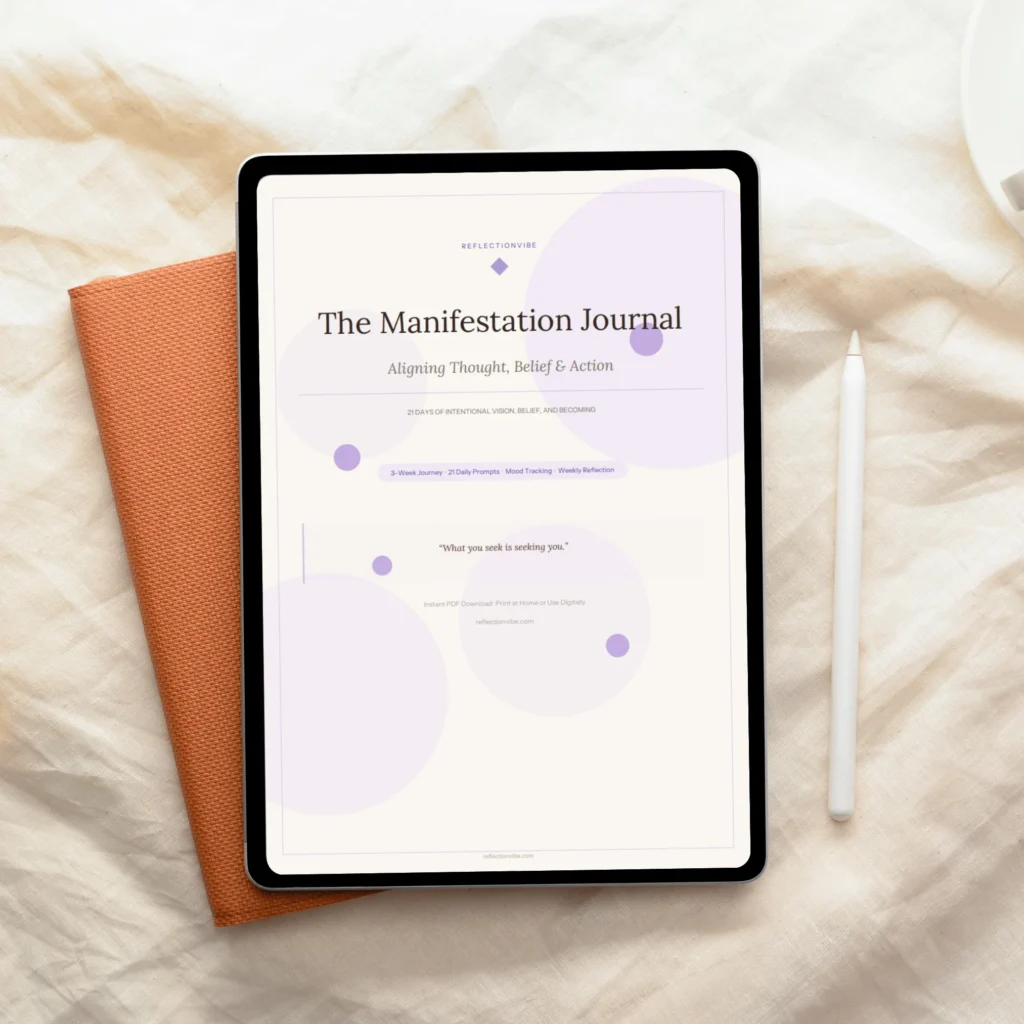
If you want a structured 21-day framework to work through all three pillars, the Manifestation Journal from ReflectionVibe takes you through exactly that — vision and clarity in week one, belief and identity in week two, action and alignment in week three. Each day includes a guided prompt, writing space, and a daily intention practice.
Because manifestation without belief is just wishing. And belief without action is just dreaming.
But all three together? That is intentional becoming.
Explore more wellness journals and self-discovery resources at reflectionvibe.com